
Southeast Asia sees PV tariffs as high as 3521%
2025-05-21 14:19
On May 21, 2025, the U.S. International Trade Commission (USITC) issued a significant ruling, finding that solar cells and modules imported from Cambodia, Malaysia, Thailand, and Vietnam posed a substantial threat of injury to U.S. manufacturers and imposing punitive tariffs on the relevant products from these four countries.
According to tariff rates previously announced by the U.S. Department of Commerce, some Cambodian companies facing tariffs as high as 3,521% for refusing to cooperate with the investigation; Vietnam's average tariff was 396%; Thailand's was 375%; and Malaysia's was relatively low at 34%. The tax rates faced by different companies also vary to a certain extent. For example, JinkoSolar (5.330, 0.06, 1.14%) is subject to a combined tax rate of 41.56% on its products produced in Malaysia. Trina Solar (14.570, -0.23, -1.55%) faces a tax rate of 375.19% on its modules in Thailand, while the tariff rate on its products exported from Vietnam exceeds 200%. JA Solar's assessed tariff on modules exported from Vietnam is approximately 120%.
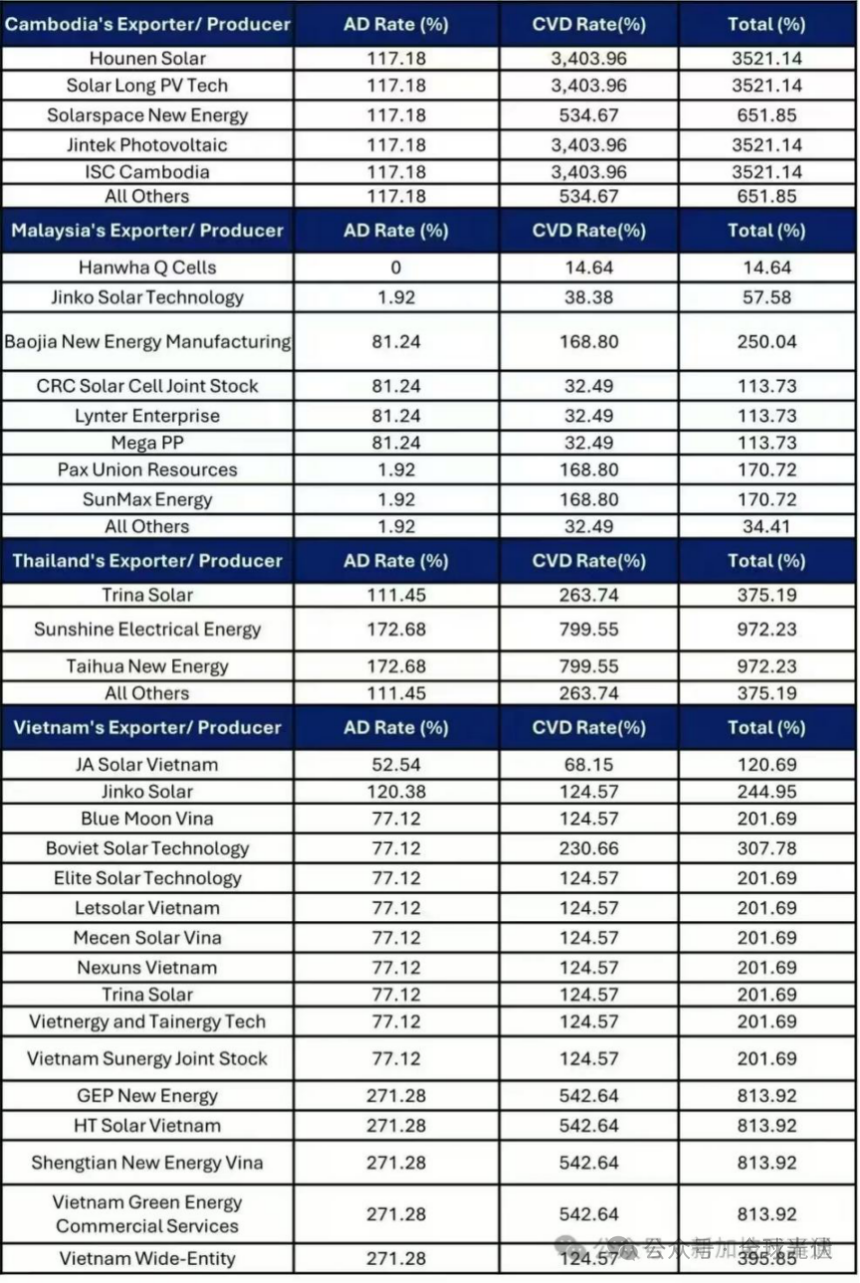
The ruling stems from a year-long trade investigation based on complaints from US solar manufacturers. These manufacturers accuse solar manufacturers in four Southeast Asian countries of benefiting from government subsidies and exporting products to the US at prices below production cost, thereby undermining the US industry. Despite the US government's previous tax incentives to promote domestic production of advanced energy technologies, these policies have failed to alleviate the competitive pressure faced by domestic manufacturers.
For US solar manufacturers, the tariffs appear to be a victory, promising to boost the development and recovery of the domestic industry. However, the US Solar Energy Industries Association (SEIA) has expressed concern that the new tariffs will increase costs for PV module buyers, harming domestic manufacturers. They may also drive up the cost of PV projects and delay the transition to clean energy.
The solar industry in the four Southeast Asian countries will be severely impacted. In Cambodia, for example, some companies face punitive tariffs as high as 3,521%. This will make their products uncompetitive in the US market, significantly reduce orders, and hinder business operations, potentially leading to some companies' closure, impacting the development and employment of related industries in the region. For Malaysia, Thailand, and Vietnam, despite relatively low tariffs, they will also have a certain impact on PV exports.
By 2024, four Southeast Asian countries will account for over 80% of US photovoltaic module imports, with Chinese companies dominating approximately 70% of this capacity. The US Department of Commerce, citing anti-dumping circumvention as an excuse, is attempting to sever Chinese photovoltaic export routes through Southeast Asia through ultra-high tariffs. According to 2024 data, Southeast Asia's photovoltaic module production capacity has shrunk to 78.8GW. Overall, Chinese photovoltaic companies hold a relatively low share of production capacity in Southeast Asia, but in the long term, forced withdrawal from the US market is not impossible.




Telephone


Company Address

No. 333, Xijiang Road, Kunshan Economic and Technical Development Zone, Jiangsu Province.